
Air Conditioning System Basics hvacr how does it work

This lesson provides an overview of air conditioning systems, highlighting their four main components: the compressor, condenser, expansion valve, and evaporator. It explains how these components work together to circulate refrigerant, absorb heat from indoor air, and release it outside, thereby cooling the indoor environment. Additionally, the lesson discusses the evolution of expansion valves, emphasizing advancements that enhance system efficiency and performance.
Capacitor charge time calculation – time constants

This lesson focuses on the charging and discharging of a capacitor in an electrical circuit, emphasizing the concept of time constants. It explains how the time constant, calculated as the product of resistance and capacitance, determines the rate at which a capacitor charges and discharges, with practical examples illustrating how changes in resistor or capacitor values affect these times. The lesson also details the voltage levels across the capacitor at each time constant, highlighting the exponential nature of the charging and discharging processes.
What is a kWh – kilowatt hour + CALCULATIONS ???????? energy bill

In this lesson, we explored the concept of kilowatt hours (kWh) as a measure of energy consumption, explaining how it is calculated by multiplying power (in kilowatts) by time (in hours). We also discussed the relationship between watts, kilowatts, and joules, and provided practical examples for calculating electricity usage and estimating monthly bills based on device power ratings and usage duration. Understanding these concepts can help individuals manage their energy consumption and costs more effectively.
How does a Transformer work – Working Principle electrical engineering

This lesson provides an introduction to transformers, essential devices in electrical engineering that transfer electrical energy between circuits using alternating current (AC). It explains the principles of electromagnetic induction, the importance of using a ferromagnetic core to enhance efficiency, and the distinctions between step-up and step-down transformers, which adjust voltage levels for various applications. Additionally, the lesson touches on three-phase transformers commonly used in commercial settings, laying a foundational understanding for further exploration in electrical engineering.
Why are transformers used?
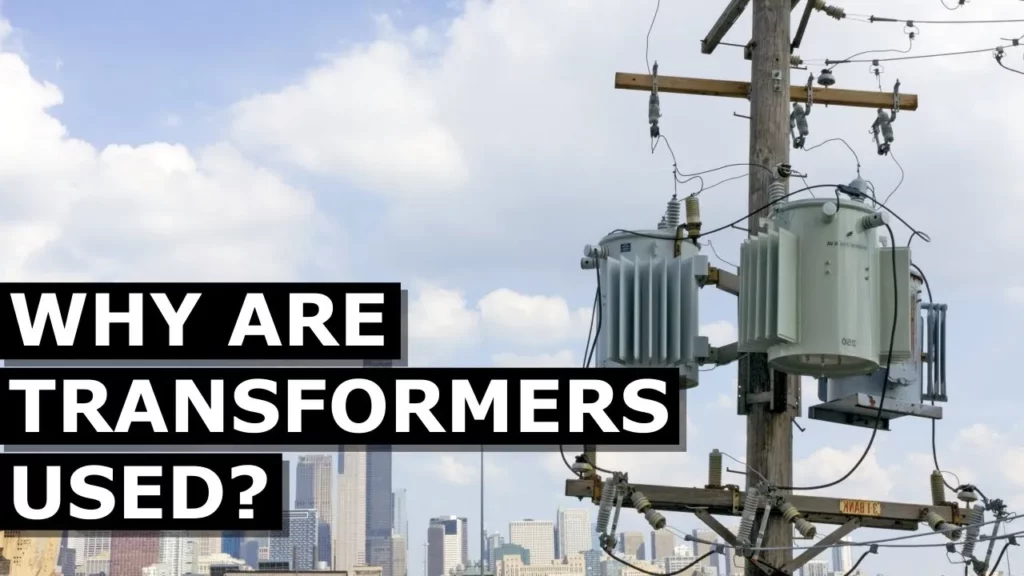
Transformers are essential in electrical systems for adjusting voltage levels, enabling efficient electricity transmission from power stations to homes. Step-up transformers increase voltage for long-distance travel, while step-down transformers reduce it for safe household use, minimizing energy loss during transmission. Understanding these mechanisms is crucial for grasping how electricity is delivered effectively across varying distances and voltage requirements.
How Three Phase Electricity works – The basics explained

This lesson provides an overview of three-phase electricity, beginning with the fundamentals of alternating current (AC) generators and the transition from single-phase to three-phase power. It explains how three-phase systems enhance efficiency by reducing flicker in lighting and delivering consistent power for industrial applications, while also highlighting their versatility in powering both large machinery and smaller devices. The article emphasizes the importance of three-phase power in commercial and industrial settings, making it the standard choice for heavy equipment.
How Do Power Outlets Work?

This lesson provides an overview of how power outlets function, emphasizing the components, color coding, and terminology used in North America, while also highlighting the universal principles applicable worldwide. It explains the roles of neutral, hot, and ground terminals, the importance of the jumper in energizing the outlet, and practical applications such as switch receptacles and connecting different hot wires. The lesson underscores the necessity of safety when working with electricity and encourages further exploration of electrical systems.
Starter Motors, what's inside?

This lesson provides an overview of starter motors, detailing their essential components and how they function to initiate a vehicle’s engine. Key parts include the solenoid, drive end frame, rotor, commutator plates, and the overrunning clutch, all of which work together to convert electrical energy into mechanical motion, enabling the engine to start. Understanding these components and their interactions is crucial for grasping the mechanics of automotive engineering.
Learn the Basics of a 3 Phase Rectifier

This lesson provides an overview of the 3-phase rectifier, a key component of a Variable Frequency Drive (VFD) that converts alternating current (AC) into direct current (DC) using six diodes. It explains the flow of current through the rectifier, the role of capacitors in smoothing the DC signal, and the subsequent conversion of DC back to AC using an inverter and Pulse Width Modulation (PWM) for precise motor control. Ultimately, the integration of these components allows for enhanced efficiency and energy savings in motor applications.
AC Electrical Generator Basics – How electricity is generated

The lesson on AC electrical generators explains the fundamental principles of electricity generation, focusing on the movement of electrons through a wire and the creation of electromagnetic fields. It details how moving magnets near coils of wire can generate alternating current (AC), and illustrates the efficiency of rotating magnets in generating electricity. Additionally, the lesson introduces the concept of three-phase power, which enhances the continuity and efficiency of electrical supply by utilizing multiple coils positioned at specific angles.